Category: Against Execution in Iran

  • Executive Summary:  Baluchistan: Dignity, Freedom, and Justice for All

    Executive Summary: Baluchistan: Dignity, Freedom, and Justice for All

    Date: December 9, 2023
    Venue: London School of Economics (LSE)

    On December 9, 2023, ACI hosted a one-day seminar titled ‘Baluchistan: Dignity, Freedom, and Justice for All,’ addressing critical human rights issues and systemic injustices in the Baluchistan region. The seminar highlighted the challenges faced by the Iranian Baloch people over the past four decades, including discrimination, poverty, and violations of their religious, ethnic, and linguistic rights. Additionally, the seminar addressed the disproportionate use of the death penalty and the continued use of lethal force against unarmed civilians, raising serious concerns regarding crimes against humanity under the ICC Statute.

    The event coincided with the 75th anniversary of the Convention on the Prevention and Punishment of the Crime of Genocide, marking a significant occasion to reflect on the importance of human rights and justice for vulnerable populations like the Baloch people.

    Key Themes and Discussions:

    1. Discrimination, Poverty, and Human Rights
      The seminar delved into the historical and ongoing challenges facing the Baloch people, focusing on issues such as multidimensional deprivation, ethnic and linguistic discrimination, and violations of basic human rights. Testimonies and discussions illuminated the severe socio-economic conditions in the region, including lack of access to education, employment, and healthcare.
    2. Systematic Use of Lethal Force and the Death Penalty
      One of the key topics of the seminar was the excessive use of lethal force against unarmed civilians and the high rates of executions in Baluchistan, with many participants emphasizing the human cost of these practices. Discussions explored how these acts may constitute crimes against humanity under international law, particularly in the context of the International Criminal Court (ICC) Statute.
    3. Testimonies and Personal Accounts
      Human rights defenders, activists, and experts shared powerful testimonies that highlighted the personal and collective suffering of the Baloch people. Among the poignant speakers were Fariba Baloch, a human rights defender, and Mohsen Borhanzehi, who recounted the events surrounding the Maki Mosque massacre in 2022. These first-hand accounts underscored the human toll of state-sanctioned violence and systemic injustice in the region.
    4. International Perspectives and Legal Frameworks
      Experts such as Professor Payam Akhavan, Professor of International Law and Special Adviser on Genocide, and Professor Javaid Rehman, UN Special Rapporteur on Human Rights in Iran, provided a legal framework for understanding the situation in Baluchistan. They analyzed how international standards and state responsibilities intersect with the ongoing violations in the region and discussed potential avenues for accountability.
    5. The Right to Education
      A significant portion of the seminar focused on the denial of education and economic opportunity for the Baloch people, particularly women and children. Speakers like Ms. Shahin Nosrati and Laebe Aram highlighted the intersectionality of cultural traditions, economic deprivation, and the lack of educational access, particularly for Baloch women. The importance of education in breaking cycles of poverty and advancing human rights was emphasized as a vital area for future advocacy.
    6. Future Prospects for Balochistan
      Panel discussions also considered potential paths forward for the region, including the role of international advocacy, legal frameworks, and grassroots efforts in addressing the systemic issues faced by the Baloch people. Activists, political analysts, and journalists underscored the need for broader international attention and intervention to ensure justice, dignity, and freedom for the people of Baluchistan.

    Closing Remarks:

    The seminar concluded with an emphasis on the importance of international solidarity, legal accountability, and the need for sustained efforts to address the grave human rights violations in Baluchistan. Several messages from prominent figures reinforced the critical need for a focused global response to ensure the protection of the rights of the Baloch people, particularly in terms of education, economic opportunity, and the prevention of violence.

    In conclusion, the seminar served as a crucial platform for raising awareness, providing testimonies, and offering legal insights into the systemic injustices faced by the Baloch people in Baluchistan, and the need for urgent action to protect their dignity, freedom, and rights.

    ——————————————————

    Film: Panel 1 – Morning session (English)

    • Opening Remarks and Welcome – Dr Hossein Ladjevardi (Persian)
    • Dr Fereydoon Rahmani – Associate Professor, Programme leader – Human Rights & Equity Studies ‘Comparative look: international standards, State responsibilities and the situation in Balochistan’
    • Ms Sabah Bandouie -‘Balochistan Human Rights Group’ UN representative ‘44 years of intentional systematic injustice’
    • Fariba Baloch – Human Rights Defeder: ‘Testimony of a mother, a woman and a Baloch human rights defender’
    • Dr Sima Sabet – Iran Expert: ‘A Strategic look to Balochistan’

    Film: Panel 2 – Morning Session (English)

    • Hon. Bijan R. Kian – Former senior official of the United States Government: ‘Intentional economic development deprivation of specific regions in Iran linked with international narcotics trafficking’
    • Nasser Boladai  – Chairperson ‘Baluchistan People’s Party’ : ‘Crimes against humanity or inconsequential killings?’
    • Professor Payam Akhavan – Professor of International Law, Special Adviser on Genocide, ICC (TBC): ‘What are crimes against humanity?’
    • Professor Javaid Rehman – United Nations Special Rapporteur on the situation of human rights in Iran: ‘Balochistan and human rights’

    Panel 2 –  14:00-18:00 (Persian)

    Prospects for the future: Wider dimensions of poverty, multidimensional deprivation and discrimination based on religious, ethnic, and linguistic rights as told by activists and human rights defenders with special emphasis on the rights to education:

    • Dr Fereydoon Rahmani – Associate Professor, Programme leader: Human Rights & Equity Studies, ‘Comparative look: international standards, State responsibilities and the situation in Balochistan’
    • Mohsen Borhanzehi – Baloch Human Rights Defender: Testimonies from Iran: Maki Mosque 30 September 2022
    • Ms Fariba Baloch – Baloch Human Rights defender: Testimony of a human rights defender
    • Dr Roya Boroumand – Boroumand Foundation: Extra Judicial Killings and Executions
    • Ms Fariba Borhanzehi – Baloch child rights defender: Story of two little children – Hangol and Morid
    • Ms Shahin Nosrati – Writer, Women’s right defender: Women: Inequitable access to education and employment opportunities
    • Laebe Aram – Writer: ‘Intersectionality of culture, tradition and economic deprivation impacting the fate of Baloch women‘
    • Dr Abdolsatar Doshoki – political analyst: ‘Inequitable access to higher education’
    • Rahim Bandouie – ‘Baluchistan People’s Party’: ‘Economic discrimination and intentional poverty’
    • Masoud Raeisi – Journalist – ‘Poverty, multi-dimensional deprivation and prospects for the future‘
    • Messages from:
    • Dr Saeed Paivandi: Importance of education in building the future
    • Dr Rezvan Moghadam:  Stop Honour Killings!
    • Shirin Razavian: A poem for Balochistan
  • ‘Baluchistan’: Dignity, Freedom, and Justice for All

    ‘Baluchistan’: Dignity, Freedom, and Justice for All

    The situation of civil, political, economic, social, cultural rights of the Iranian Baloch people

    December 9, 2023 – Marshall Building, LSE – London

    ACI is holding its fifty second international conference dedicated to the plight of the Iranian Baloch People to coincide with the seventy fifth anniversary of UN Human Rights Day with its theme of ‘Dignity, Freedom and Justice for All’.

    This one day seminar proposes to discuss the wider dimensions of poverty, multidimensional deprivation and discrimination based on religious, ethnic and linguistic rights to give context to the grievances and challenges facing the Iranian Baloch People in over four decades. Along with the issues concerning discrimination, poverty and human rights, the question we aim to discuss further is the continuous disproportionate use of the death penalty and the systematic use of lethal force against unarmed civilian population leading to many deaths in the Baluchistan region with regard to the ICC Statute and crimes against humanity. December 9, 2023, also marks the 75th anniversary of the landmark Convention on the Prevention and Punishment of the Crime of Genocide (Genocide Convention). This was the first human rights treaty adopted by the General Assembly.

    Panel 1 – 10:00 – 13:00 (ENGLISH)

    Along with the issues concerning discrimination, poverty and human rights, the question we aim to discuss further is the continuous disproportionate use of the death penalty and the systematic use of lethal force against unarmed civilian population leading to many deaths in the Baluchistan region with regard to the ICC Statute and crimes against humanity:

    Film: Panel 1 – Morning session (English)

    • Opening Remarks and Welcome – Dr Hossein Ladjevardi (Persian)
    • Dr Fereydoon Rahmani – Associate Professor, Programme leader – Human Rights & Equity Studies ‘Comparative look: international standards, State responsibilities and the situation in Balochistan’
    • Ms Sabah Bandouie -‘Balochistan Human Rights Group’ UN representative ‘44 years of intentional systematic injustice’
    • Fariba Baloch – Human Rights Defeder: ‘Testimony of a mother, a woman and a Baloch human rights defender’
    • Dr Sima Sabet – Iran Expert: ‘A Strategic look to Balochistan’

    Film: Panel 2 – Morning Session (English)

    • Hon. Bijan R. Kian – Former senior official of the United States Government: ‘Intentional economic development deprivation of specific regions in Iran linked with international narcotics trafficking’
    • Nasser Boladai  – Chairperson ‘Baluchistan People’s Party’ : ‘Crimes against humanity or inconsequential killings?’
    • Professor Payam Akhavan – Professor of International Law, Special Adviser on Genocide, ICC (TBC): ‘What are crimes against humanity?’
    • Professor Javaid Rehman – United Nations Special Rapporteur on the situation of human rights in Iran: ‘Balochistan and human rights’

    Panel 2 –  14:00-18:00 (Persian)

    Prospects for the future: Wider dimensions of poverty, multidimensional deprivation and discrimination based on religious, ethnic, and linguistic rights as told by activists and human rights defenders with special emphasis on the rights to education:

    • Dr Fereydoon Rahmani – Associate Professor, Programme leader: Human Rights & Equity Studies, ‘Comparative look: international standards, State responsibilities and the situation in Balochistan’
    • Mohsen Borhanzehi – Baloch Human Rights Defender: Testimonies from Iran: Maki Mosque 30 September 2022
    • Ms Fariba Baloch – Baloch Human Rights defender: Testimony of a human rights defender
    • Dr Roya Boroumand – Boroumand Foundation: Extra Judicial Killings and Executions
    • Ms Fariba Borhanzehi – Baloch child rights defender: Story of two little children – Hangol and Morid
    • Ms Shahin Nosrati – Writer, Women’s right defender: Women: Inequitable access to education and employment opportunities
    • Laebe Aram – Writer: ‘Intersectionality of culture, tradition and economic deprivation impacting the fate of Baloch women‘
    • Dr Abdolsatar Doshoki – political analyst: ‘Inequitable access to higher education’
    • Rahim Bandouie – ‘Baluchistan People’s Party’: ‘Economic discrimination and intentional poverty’
    • Masoud Raeisi – Journalist – ‘Poverty, multi-dimensional deprivation and prospects for the future‘
    • Messages from:

    Organised by Association des Chercheurs Iraniens (ACI) in collaboration with Azadi Network and Balochistan Human Rights Group

  • ‘Balochistan’ – ‘Dignity, Freedom, and Justice for All’

    Press Release : ‘Tehran funds Hamas while starving children at home’.

    The situation of civil, political, economic, social, cultural rights of the Iranian Baloch People

    Saturday 9 December 2023 – 10:00-13:00 English, 14:00-18:00 Persian

    Marshall Theatre, The Marshall Building, LSE, 44 Lincoln’s Inn Fields, London WC2A 3LY

    (On Saturday the Entrance is accessed through Portugal Street opposite the LSE Library)

    SPEAKERS LIST

    One day seminar in London examines possible ‘crimes against humanity’ committed against Iranian Baloch people on ‘Zahedan’s Bloody Friday’ with UN rights experts and Baloch minority activists and human rights defenders.

    While with the Israel-Gaza war, Iran’s prioritising of funding for terrorism is headlining international news, at home the latest annual budget keeps the Balochistan province as the most deprived and under invested province in Iran.

    The seminar will hear from Baloch activists who accuse the regime of intentional policies of keeping the region underdeveloped and deprived to further its aim of illicit gain from drugs smuggling. The ingress point for Billions of dollars in street value of narcotics is 565 miles of the province’s common border with Pakistan and 572 miles of common border with Afghanistan.

    The morning panel (10am-1pm) in English, will hear from Prof Javaid Rehman the UN Special Rapporteur on the situation of human rights in Iran who has said that the “scale and gravity” of violations committed by Iranian authorities during the ‘Women Life Freedom’ movement in Balochistan pointed to “the possible commission of international crimes, notably the crimes against humanity of murder, imprisonment, enforced disappearances, torture, rape and sexual violence, and persecution”. Prof Payam Akhavan, Professor of International Law, Special Adviser on Genocide, International Criminal Court will discuss the recent events. The panel will hear firsthand accounts of the plight of families whose loved ones have been executed, killed and/or sustained life changing injuries during the ‘Bloody Friday’ on September 30, 2023.

    The afternoon panel (2-6pm) in Persian, examines the wider dimensions of religious and ethnic persecution and violence against the Iranian Baloch people through the regime’s economic and security policies. Poverty is deep-rooted. According to a Baloch MP in April this year ‘deep rooted poverty in the region means that people can only afford to eat subsidised bread and provisions for that are even failing to meet the demands’. Reports on the region’s inequitable access to education, housing, healthcare, employment, and crumbling infrastructure will examine their impact on the rights of women and children in particular.

    Looking to the future, the seminar will conclude with its call for action and recommendations. Ends.

    Further information

    Organised by Association des Chercheurs Iraniens (ACI) in collaboration with Azadi Network and Balochistan Human Rights Group

    Background information:

    Sistan and Balochistan, the third largest of Iran’s 31 provinces, sits in the southeast corner of Iran with access to the waters of the Persian Gulf. It borders Pakistan and Afghanistan.

    Balochistan has 3.3 million inhabitants. It is also home to over 700000 Afghan refugees. It has had one of the highest rates of population growth in Iran with 67% of the population below 30 years of age. 28% of this group are between 15-30 years of age. This young population presents huge potential for future growth if planned for correctly while simultaneously creating real problems for the regime that has so far failed to meet the demands and aspirations of the people.

    The Balochistan region in the most deprived province in Iran according to the Islamic Republic’s own figures. It has the worst access to education, healthcare, housing, employment opportunity. Over 60% of the population live under poverty line.

    At least 274 Baluch people have been executed for drug-related charges since 2021, 40% of all drug executions in that time period. This is while they only make up 2-5% of Iran’s population[1].

    On 30 September 2022, during Friday Prayers in Zahedan the regime’s forces opened fire on unarmed civilians. According to Amnesty International at least 82 Baluchi protesters and bystanders were killed in bloody crackdown. ‘Iranian security forces unlawfully killed at least 66 people, including children, and injured hundreds of others after firing live ammunition, metal pellets and teargas at protesters, bystanders and worshippers during a violent crackdown after Friday prayers on 30 September in Zahedan, Sistan and Baluchistan province, Amnesty International said today. Since then, another 16 people were killed in separate incidents in Zahedan amid an ongoing clampdown on protests. Evidence gathered from activists, victims’ families, eyewitness testimonies, and images and videos of the protests suggest the real death toll from Zahedan is likely to be higher.’[2]

    Poor water management and changing climate, have created draughts and debilitating dust storms which have severely impacted the lives of the indigenous people of the region[3].


    [1] https://iranhr.net/en/reports/35/

    [2] https://www.amnesty.org/en/latest/news/2022/10/iran-at-least-82-baluchi-protesters-and-bystanders-killed-in-bloody-crackdown/

    [3] https://www.nationalgeographic.com/environment/article/drought-climate-change-turn-iran-sistan-and-baluchestan-into-dust-bowl

  • ‘Balochistan’: ‘Dignity, Freedom, and Justice for All’

    ‘Balochistan’: ‘Dignity, Freedom, and Justice for All’

    The situation of civil, political, economic, social, cultural rights

    of the Iranian Baloch People

    Saturday 9 December 2023 – Central London

    Space is limited so please register
    List of Speakers

    ACI would like to announce ACI its fifty second international conference dedicated to the plight of the Iranian Baloch People to coincide with the seventy fifth anniversary of UN Human Rights Day with its theme of ‘Dignity, Freedom and Justice for All’.

    This one day seminar proposes to discuss the wider dimensions of poverty, multidimensional deprivation and discrimination based on religious, ethnic and linguistic rights to give context to the grievances and challenges facing the Iranian Baloch People in over four decades. Along with the issues concerning discrimination, poverty and human rights, the question we aim to discuss further is the continuous disproportionate use of the death penalty and the systematic use of lethal force against unarmed civilian population leading to many deaths in the Baluchistan region with regard to the ICC Statute and crimes against humanity.

    Speakers include Dr Javaid Rehman United Nations Special Rapporteur on the situation of human rights in the Islamic Republic of Iran who will examine the present day situation of the Iranian Baloch people alongside other international experts, Baloch activists and human rights defenders.

    Panel 1 (English) – 10:00 – 13:00

    Along with the issues concerning discrimination, poverty and human rights, the question we aim to discuss further is the continuous disproportionate use of the death penalty and the systematic use of lethal force against unarmed civilian population leading to many deaths in the Baluchistan region with regard to the ICC Statute and crimes against humanity

    Panel 2 (Persian) –  14:00-18:00

    Prospects for the future: Wider dimensions of poverty, multidimensional deprivation and discrimination based on religious, ethnic and linguistic rights as told by activists and human rights defenders

    Subjects for consideration in Persian and English include but are not limited to:

    • Extreme poverty and human rights
      • Unemployment and employment opportunities
      • Housing rights
      • Access to healthcare
    • Rights of the Child:
      • access to education
      • child marriage
      • child labour
      • child soldier
    • Minority rights: Equality and equity
      • Women’s rights
      • Religious freedoms
      • Ethnic and linguistic rights
    • Civil and political rights
      • Brutal treatment of civilian population leading to deaths: ‘Crimes Against Humanity’?
      • Illegal detention, poor prison conditions, unfair trials,
      • Disproportionate and increasing use of the death penalty.
      • Political participation/office

    This conference is convened in collaboration with Azadi Network and Balochistan Human Rights Group

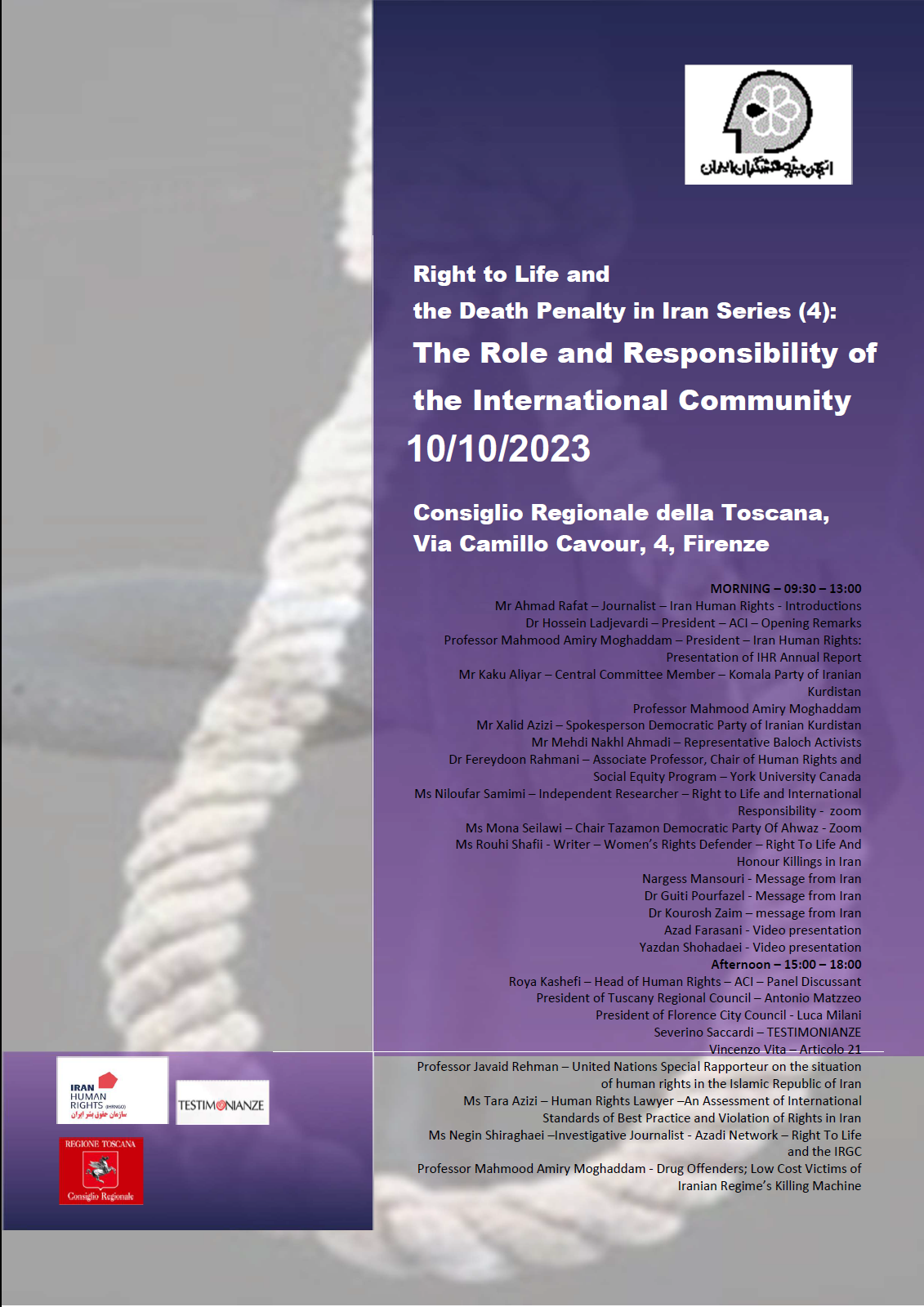
  • Right to Life and the Death Penalty in Iran

    Right to Life and the Death Penalty in Iran

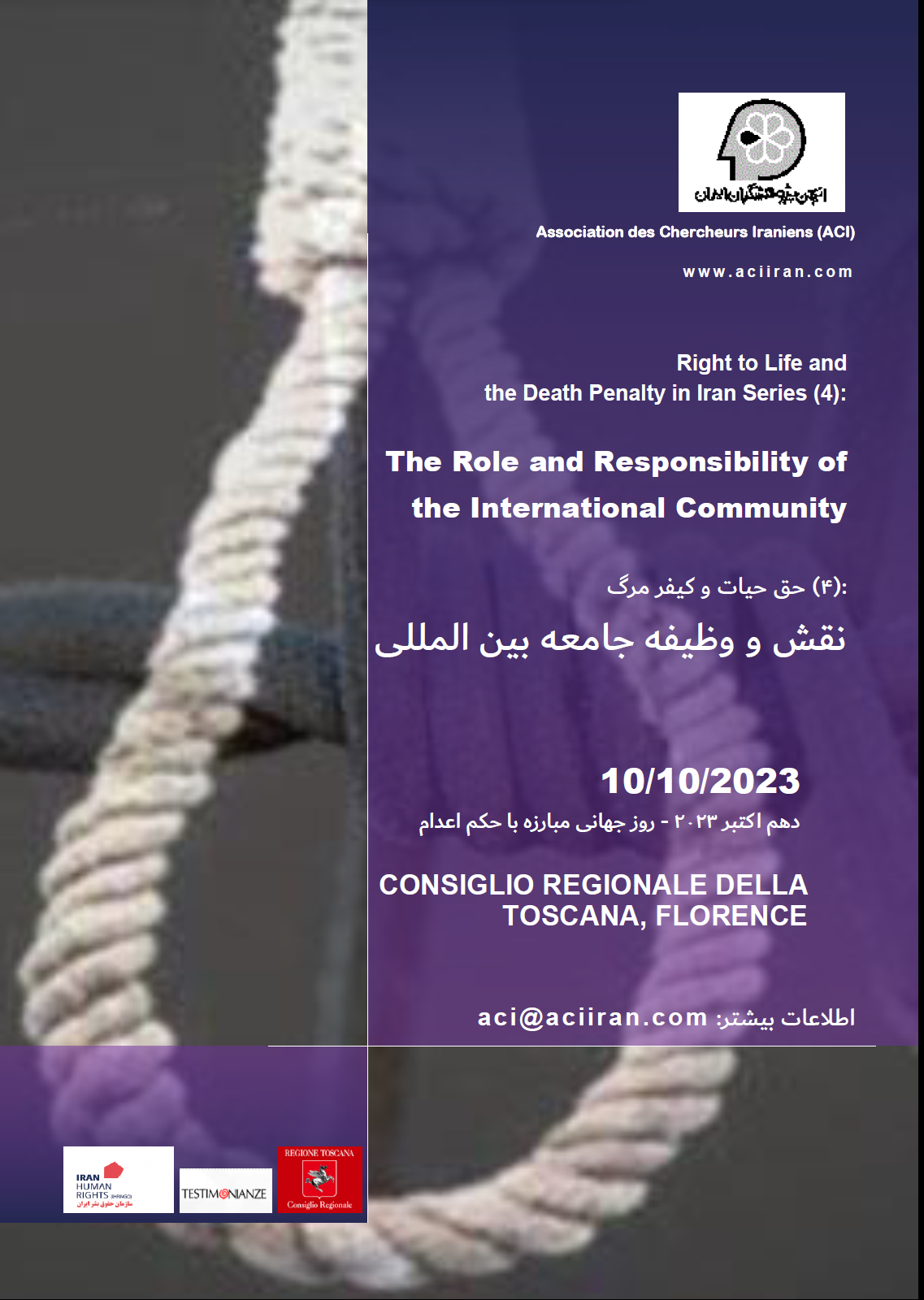
    ‘The Role and Responsibility of the International Community’ – (series 4)

    Date:                 10 October 2023 – 9:30-18:00

    Location:          Consiglio Regionale, Via Camillo Cavour, 4, 50129 Florence

    In Collaboration With: Testimonianze, Iran Human Rights – Italia (IHRNGO) and Supported by: Consiglio Regionale della Toscana

    On March 15, 2023, UNODC signed a Country Partnership Programme with the Islamic Republic of Iran for 2023-2026. It is stated that this Programme aims to further strengthen the cooperation between the UNODC and Iran on drugs, crime, international criminal justice, corruption, and alternative livelihood through promoting United Nations standards and international best practice.

    The UNODC guidance on the protection of human rights in countries where aid is provided for anti-drugs programmes explicitly acknowledges the links between funding and executions and recommends withdrawal of support where improvements were not made. While there is clearly a need for international cooperation on counter-narcotics efforts, this must be proportionate to right to life and respect for human rights.

    In view of the increased number of executions in Iran on drugs related charges this year alone, our conference’s focus is the role and responsibility of the international community:

    1. How is the international community and the UN agencies reconciling the use of the death penalty and lashes as punishments – even for addicts – with United Nations standards and international best practice?
    2. How is the international community and the UNODC resolving the contradictions between cooperation with the IRGC and the regime with the fact that IRGC is complicit in international organised crime and drugs trafficking?
    3. How is the international community and the UNODC resolving the increased numbers of arrests, detentions, torture and ill treatment and unfair biased trials for protestors in the last year with UN standards and international best practice?
    4. What is the role and responsibility of the international community when the State not only fails to protect the safety and security of its people but, poisons, maims, kills and executes its people?

    Speakers

    MORNING – 09:30 – 13:00
    Film: Part One
    Mr Ahmad Rafat – Journalist – Iran Human Rights – Introductions
    Dr Hossein Ladjevardi – President, ACI – Welcome and Opening Remarks
    Professor Mahmood Amiry Moghaddam – President, Iran Human Rights (IHRNGO) : Presentation of IHR Annual Report  
    Film:Part Two
    Alphabetical order:
    Mr Kaku Aliyar – Central Committee Member – Komala Party of Iranian Kurdistan
    Mr Xalid Azizi – Spokesperson Democratic Party of Iranian Kurdistan
    Mr Mehdi Nakhl Ahmadi – Representative of Baloch Activists
    Dr Nargess Eskandari-Grünberg – Mayor of Frankfurt: Message of solidarity – Zoom
    Dr Fereydoon Rahmani – Associate Professor, Chair of Human Rights and Social Equity Program – York University Canada
    Ms Niloufar Samimi – Independent Researcher – Right to Life and International Responsibility –  zoom
    Ms Mona Seilawi – Chair Tazamon Democratic Party Of Ahwaz – Zoom
    Ms Rouhi Shafii – Writer – Women’s Rights Defender – Right To Life And Honour Killings in Iran
    Mr Fazel Walian – HANA , human rights group
    Azad Farasani – Video presentation
    Yazdan Shohadaei – Video presentation
    Messages from Iran
    Nargess Mansouri – Message from Iran
    Dr Guiti Pourfazel – Message from Iran
    Dr Kourosh Zaim – message from Iran

    Afternoon – 15:00 – 18:00
    Roya Kashefi – Head of Human Rights – ACI – Panel Chair
    Film: Part One
    Ahmad Rafat – Introductions
    Welcome Address from Antonio Matzzeo, President of Tuscany Regional Council
    Luca Milani, President of Florence City Council

    Severino Saccardi – TESTIMONIANZE
    Senator Vincenzo Vita – Articolo 21
    Film: Part Two
    Professor Javaid Rehman – United Nations Special Rapporteur on the situation of human rights in the Islamic Republic of Iran
    Ms Tara Azizi – Human Rights Lawyer – An Assessment of International Standards of Best Practice and Violation of Rights in Iran
    Ms Negin Shiraghaei – Investigative Journalist – Azadi Network – Right To Life and the IRGC
    Film: Part Three
    Professor Mahmood Amiry Moghaddam – Head of IHRNGO Drug Offenders; Low Cost Victims of Iranian Regime’s Killing Machine
    Closing Remarks and ceremony

    In Collaboration With: Testimonianze, Iran Human Rights – Italia
    Supported by: Consiglio Regionale della Toscana  
  • Right to Life and the Death Penalty in Iran (4)

    Right to Life and the Death Penalty in Iran (4)

    The Role and Responsibility of

    the International Community

    10 October 2023

    World Day Against the Death Penalty

    Consiglio Regionale della Toscana, Via Camillo Cavour, 2, 50129 Florence—Italy

    On March 15, 2023, UNODC signed a Country Partnership Programme with the Islamic Republic of Iran for 2023-2026. It is stated that this Programme aims to further strengthen the cooperation between the UNODC and Iran on drugs, crime, international criminal justice, corruption, and alternative livelihood through promoting United Nations standards and international best practice. Its strategic goals are in keeping with the United Nations Sustainable Development Cooperation Framework (UNSDCF) for the Islamic Republic of Iran 2023-2027 also signed earlier this year.

    The UNODC guidance on the protection of human rights in countries where aid is provided for anti-drugs programmes explicitly acknowledges the links between funding and executions and recommends withdrawal of support where improvements were not made. While there is clearly a need for international cooperation on counter-narcotics efforts this must be proportionate to right to life and respect for human rights.

    In view of the increased number of executions in Iran on drugs related charges this year alone, our forthcoming conference will focus of the role and responsibility of the international community.

    1. How is the international community and the UN agencies resolving the use of the death penalty and lashes as punishments – even for addicts – with United Nations standards and international best practice?
    2. How is the international community and the UNODC resolving the contradictions between cooperation with the IRGC and the regime with the fact that IRGC is complicit in international organised crime and drugs trafficking?
    3. How is the international community and the UNODC resolving the increased numbers of arrests, detentions, torture and ill treatment and unfair biased trials for protestors in the last year with UN standards and international best practice?

    ACI proposes to discuss the use of the death penalty as a tool of oppression as well as the above in view of the alarming increase in the number of executions in 2023 and the dual role and responsibility of International Community.

    This conference is convened in collaboration with

    Iran Human Rights Centre-Italia 

    Testimonianze

    Supported by:

    Consiglio Regionale della Toscana

  • The Right to Life and the Death Penalty in Iran – Conference Series

    The Right to Life and the Death Penalty in Iran – Conference Series

    In view of the increased number of executions in Iran on drugs related charges this year alone, our forthcoming conference will focus of the role and responsibility of the international community:

    1. How is the international community and the UN agencies resolving the use of the death penalty and lashes as punishments – even for addicts – with United Nations standards and international best practice?
    2. How is the international community and the UNODC resolving the contradictions between cooperation with the IRGC and the regime with the fact that IRGC is complicit in international organised crime and drugs trafficking?
    3. How is the international community and the UNODC resolving the increased numbers of arrests, detentions, torture and ill treatment and unfair biased trials for protestors in the last year with UN standards and international best practice?
    4. What is the role and responsibility of the international community when the State not only fails to protect the safety and security of its people but, poisons, maims, kills and executes its people?

    Previous Conferences

    Download PDF

    Introduction

    Iran has the highest rate of executions per capita, and the numbers are increasing at an alarming rate. In keeping with ACI’s aims and objectives of finding solutions and building a better future for Iran, ACI has undertaken a series of studies and surveys to find out how the death penalty can be abolished in Iran. Key questions to consider include:

    • International obligations and Human rights standards vs. national laws;
    • Can the death penalty be abolished in view of the present-day religious and ideological laws in Iran;
    • Qesas, the law of retribution;
    • ‘Serious crimes’ or ‘exceptional circumstances’;
    • Alternative punishments for worst offenders;
    • Executions as deterrents;
    • Victim’s rights vs. community rights;
    • Possible execution of innocent persons;
    • The use of the death penalty as a tool of intimidation, oppression and control;
    • Due process and prison conditions for death row inmates

    The recurring question to be examined at all conferences concerns public opinion and the role and responsibility of mass media:

    • The role and impact of traditional mass media vs. social media;
    • The role of social media in improving community cohesion;
    • The policy impact of media reporting and media bias;
    • The dynamics between the mass media and special interest groups;
    • The issues behind media financing;
    • An independent media with a diversity of views;
    • The relationship between mass media and power

    The Conference Series

    To date, one internet survey and three conferences have been undertaken with a further conference proposed in the near future.

    All conferences are live streamed and the films of past conferences are available on ACI’s YouTube channel. Presented papers are published in a book available from any of ACI’s offices.

    Below is a brief report of past work:

    Conference 1:

    Right to Life and Death Penalty in Iran:

    The Regime’s Instability and the Deployment of Violence and Executions

    5/6 December 2009 – Cologne, Germany

    Following the disputed presidential elections in Iran and in view of the widespread deployment of violence, intimidation, rape, imprisonment and the ultimate cruel, inhuman and degrading punishment ‘the death penalty’, ACI organised an emergency conference in Cologne-Germany with the aim of reaching a coordinated and concerted effort in opposing and working towards abolishing the death penalty in Iran, in all cases, regardless of the nature of the crime, the characteristics of the offender, or the method used by the regime to kill the prisoner. The following key issues were examined:

    • The sociological aspect of the use of the death penalty
    • Human rights: the violation of fundamental rights in Iran
    • The use of violence and the death penalty against Iran’s ethnic groups
    • The use of violence and the death penalty against Iran’s religious groups
    • A realistic assessment of the regime’s instability and the deployment of violence and executions

    At the conclusion of the conference, a consensus was reached by all participants comprising Iranian ethnic and religious groups and human rights groups and defenders. The following pledge was signed and others were invited to join leading to a campaign entitled ‘Be our Voice’.

    “…We, the undersigned, believe that all Iranians without distinction of any kind, such as race, colour, sex, language, religion, political or other opinions, national or social origin, property, birth or other status are equal and for this reason, we condemn all cases of execution throughout Iran and commit to full and mutual support for each other

    We, the undersigned, invite all individuals, groups, organizations, parties and human rights activists and organizations to join us in condemning the use of the ultimate violence, the death penalty, in Iran. With your help, we can employ global networks and opportunities in order to support the persecuted in Iran and end executions that are taking place all over Iran today.

    May we be the voice of the voiceless in Iran who are the helpless victims of systematic and escalating state-sponsored violence…”

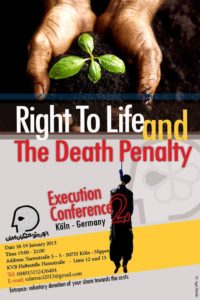
    Conference 2

    Right to Life and Death Penalty in Iran (2):

    Human Rights and Death Penalty as a tool of oppression

    18/19 January 2014 – Cologne, Germany

    On day one of this conference the key question of ‘the right to life and the death penalty’ was discussed with regard to overall laws and religious practices in Iran. The consequences and affects of violent laws and public executions on society were among important topics of discussion.

    Findings of a dedicated public opinion survey on the “Right to Life and the Death Penalty in Iran” were presented to the conference. Out of the 1111 confirmed and verified responses only 9% of the participants supported the death penalty

    The showing of a moving and award-winning documentary about the plight of three minors on death row also took discussions further concerning State perpetuated the cycle of violence when the responsibility of making life or death decisions is passed on to the aggrieved families of victims.

    In a taped message from Iran, we heard from activists who work relentlessly on securing pardons for death row prisoners such as the young minors in the documentary and the invaluable role of sportsmen, actors and public figures in these efforts.

    Day Two of the conference heard from Iran’s ethnic and religious groups and the use of the death penalty as a tool of oppression. Through a taped phone message, we heard the pleas of a young Sunni Kurd on death row, imprisoned at Rajaie Shahr prison, who bravely told the conference of repeated failures and injustices he had experienced. We also shared the tragic story of a mother whose two young sons were executed in Iran.

    At the beginning of the last panel, we received a message of support from campaigners within Iran who welcomed the active cooperation of the Iranian diaspora in upholding the ‘right to life’. This was followed by an examination of the importance and relevance of public opinion on policy decisions and the role of media in reporting executions. We heard from experienced journalists with national and international experiences about the opportunities and obstacles to unbiased objective reporting in Iran. Legal experts discussed the duties of governments, the effects of laws on changing culture and the importance of education in raising public awareness about the right to life and the death penalty.

    At the conference’s conclusion, the participants proposed that ACI set up and coordinate a coalition made up of all Iranian abolitionists to pull resources together and work in a cogent, cohesive manner towards this common objective. In accepting this arduous task ACI has invited the cooperation and participation of all interested parties and is at present working on a plan of action.

    The interactions with colleagues, activists and human rights defenders in Iran were a most valuable contribution to the proceedings and their input was an asset in the fight against the death penalty in Iran.

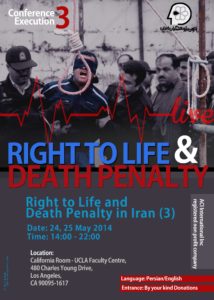
    Conference 3

    Right to Life and Death Penalty in Iran (3):

    Social and legal aspects of death penalty in Iran and USA

    24/25 May 2014 – Los Angeles, USA

    In this third conference, the proceedings heard the valuable contributions of US and international organisations such as the ‘American Civil Liberties Union – ACLU’ and ‘Reprieve’ who offered valuable insight into the application and execution of the death penalty in the USA and the importance of raising awareness through carefully planned campaigns.

    As in the previous conferences, this gathering also benefited from the active participation of colleagues in Iran.

    The key question for consideration at this conference was the likelihood of abolishing the death penalty in Iran in view of existing religious and ideological laws which were discussed extensively.

    The media panel highlighted the importance of unbiased reporting and respect for the families of victims when campaigning for pardons in murder cases. The great value of the complimentary work of reporters and journalists in and out of Iran was also discussed.

    We were privileged to close the conference with a short performance by international award-winning actress Shohreh Aghdashloo.

    Conference concluded with the following recommendations:

    1. Raising awareness and dialogue with ordinary members of public must be at the top of the agenda of any successful campaign against the death penalty in Iran;
    2. Safe support for civil society and grass roots activists against the death penalty in Iran;
    3. Informing and engaging the international community to bear pressure on the Islamic Republic on the issue of death penalty in Iran

    Poetry and Lyric Competition

    24 May – 1 September 2014

    ACI’s third conference in this series also saw the launch of a poetry and lyric competition. Entrants were invited to send in their work by the first of September 2014 for selection and publication in time for 10 October 2014 World Day Against Death Penalty. We are fortunate to have Iraj Janati Ataei, renowned Iranian lyricist and playwright, among the judging panel.

    In support of this competition Iranian music star, Morteza, allowed ACI the first broadcast of a demo version of a special piece against the death penalty in Iran which is now available on ACI’s You Tube channel.

    Survey: Death Penalty in Iran

    01 December 2013 – 15 January 2014

    ACI conducted a 45 day internet survey on the question of the death penalty in Iran. As a sign of sensitivity to the topic the survey site was hacked and fell prey to three separate ‘phishing’ attempts by the Islamic Republic.

    This survey, as with all of our other surveys, did not ask for the personal details of the respondents and limited itself to demographic questions. However, the fake survey page asked respondents from Iran to enter their names and email addresses before completing the survey.

    Nevertheless, ACI’s technical experts recovered the survey. The respondents were mainly from Iran, Europe, the United States and Canada respectively. Their responses can be categorised and evaluated based on age, gender, education, employment, religion, place of birth, place of residence and other factors included in the demographic section of the survey.

    Out of the 1111 respondents, 67% men and 23% women participated. The biggest age group participating in the survey were the 40-59 year olds.

    In total, only 9% of the respondents supported some form of execution, the majority of whom supported Qesas (law of retribution). Men supported the use of the death penalty as a punishment twice more than women.

    The full analysis is available upon request.

    Future Proposed Conferences

    Conference 4

    Day One:

    Mass Media influence on society and public policy

    Day 2:

    Criminal Justice system and the death penalty

    Conference 5

    Day One:

    International standards, due process and prison conditions in Iran for death row inmates

    Treatment of female death row inmates

    Day Two:

    Mass Media influence on society and public policy

    Transitional justice and the death penalty in the future of Iran

    ACI maintains an impartial and unprejudiced approach

    to all its activities and respects all schools of thought.

    We work actively with colleagues from all over the world

    and hope to contribute towards a better future for Iran.

    We welcome and invite the participation of all interested in Iran’s future. 

    ACI international Inc registered non-profit organisation exempt under section 501 (c) (3)

  • Be Our Voice!

    Campaign against executions in Iran – February 2010

    “…We, the undersigned, believe that all Iranians without distinction of any kind, such as race, colour, sex, language, religion, political or other opinions, national or social origin, property, birth or other status are equal and for this reason, we condemn all cases of execution throughout Iran and commit to full and mutual support for each other

    We, the undersigned, invite all individuals, groups, organizations, parties and human rights activists and organizations to join us in condemning the use of the ultimate violence, the death penalty, in Iran. With your help, we can employ global networks and opportunities in order to support the persecuted in Iran and end executions that are taking place all over Iran today.

    May we be the voice of the voiceless in Iran who are the helpless victims of systematic and escalating state-sponsored violence…”

    list of initial signatures:

    GROUPS

    Ahwaz Human Rights Organisation (http://www.ahwazhumanrights.org/)
    Akhbar Rooz (http://www.akhbar-rooz.com/index.jsp )
    Association des Chercheurs Iraniens – ACI
    Azarmehr Association (http://www.zananeazarmehr.blogsky.com/)
    Baluchistan Peoples Front (BPF) (http://balochistanpeoplesfront.blogspot.com/)
    Baluchistan People’s Party (www.balochPeople.org)
    Centre for Baluchistan Studies (www.balochstudy.com)
    Committee of Human Rights Reporters (http://www.schrr.net)
    Democratic Party of Iranian Kurdistan (PDKI) (http://pdki.org)
    International Coalition Against Torture – InCAT (http://incat.org/index.php)
    Iran Communist Party (www.cpiran.org/)
    Iranian Human Rights Activist Groups in EU and North America – IHRAG (www.komitedefa.org)
    Komala Party – Iranian Kurdistan (http://komala.org/)
    IRQO (http://www.irqo.org/)
    Komala Party of Kurdistan (http://www.komala.net/)
    Kurd Human Rights Organisation in Europe
    Kurdsish American Committee for Human Rights and Democracy in Iran (www.vokradio.com)
    Kurdistan Democratic Party
    Organisation of Kurmanj People
    Partners for Rights (http://www.partners-for-rights.org/)
    Pezhvak-e-Iran (http://www.zananeazarmehr.blogsky.com/)
    Reporters and Human Rights Activists in Iran (http://rhairan.com)

    INDIVIDUALS

    BACK Asghar Abdi – Researcher
    Karim Abdian – Ahwaz Human Rights Organisation
    Ferydoon Ahmadi – Political Activist
    Nastaran Amjadi – Human Rights Activist
    Jalil Azadikhah –  Journalist, Komala Party of Kurdistan
    Nahid Bahmani – Central Committee Member: Komala Party – Iranian Kurdistan
    Rahim Bandoui – Executive Bureau: Baluchistan People’s Party (BPP)
    Niloofar Bayzaie – Writer and Director
    Nasser Bolidai – Spokesperson: Baluchistan People’s Party (BPP)
    Haydeh Daragahi – Human Rights Activist
    Abdul-Sattar Doshoki – The Centre For Baluchistan Studies
    Soray Fallah – World’s Women for Life
    Jamsheed Farooghi – Head of Persian Service Deutsche Welle
    Saghi Ghahreman – IRQO
    Fereshteh Ghazi – Journalist
    Khaled Hassanpour  – Kurdistan Democratic Party
    Nasser Hesami – Head of Asosat TV Komala Party of Kurdistan
    Reza Hossein Borr – Baluchistan Peoples Front (BPF)
    Shahu Hosseini – International Representative: Democratic Party of Iranian Kurdistan (PDKI)
    Omar Ilkhanizadeh – Chairman Komala Party of Kurdistan
    Rahman Javanmardi – Human Rights Activist
    Reza Kaabi – Member of Central Committee – Komala Party of Kurdistan
    Behzad Karimi – Political Activist
    Roya Kashefi – Head of Human Rights Committee – ACI
    Narges Kermanshahi – Women’s Voice – Canada
    Mitra Khalatbari – Journalist
    Hossein Ladjevardi – President – ACI
    Sirus Malakooti – ACI
    Mohamad Mesri – Komala Party – Iranian Kurdistan
    Rezvan Moghadam – Women’s Rights Activist
    Verya Mohamadi – Komala Party of Kurdistan
    Abdullah Mohtadi – Chairman Komala Party – Iranian Kurdistan
    Hamila Nisgilli – Member of Central Committee Rahe Kargar
    Shiva Nojo – Peace Activist
    Hamid Parnian – IRQO, editor of Cheraq
    Jamileh Rahimi – Member of Central Committee – Komala Party of Kurdistan
    Bahram Rahmani – Committee Member: Iranian Writers Association (in Exile)
    Rahim Rashidi – Journalist
    Jahanbakhsh Rostami – Kurdish-German Cultural Centre
    Setareh Sabety – Journalist / Writer
    Zia Sadrolashrafi – Spokesperson ‘Congress of Nationalities of Federal Iran
    Mojtaba Samienejad – Reporters and Human Rights Activists in Iran
    Asad Seif – Writer
    Rouhi Shafii – Human Rights Activist / Writer
    Elahe Sharifpour-Hicks – Partners for Rights
    Afrasiab Shekofteh – Organisation of Kurmanj People
    Foad Taban – Chief Editor, Akhbar Rooz
    Nosrat Teimourzadeh -Central Committee of Komalah and Communist Party of Iran
    Behnam Vafaseresht – Human Rights Activist
    Tonia Valioghli – Committee in Solidarity with Mourning Mothers of Iran
    Mina Zarin – Human Rights Activist


  • Enough is Enough – 3

    Enough is Enough – 3

    Mr Josep Borrell

    Chair of The Foreign Affairs Council,

    the EU High Representative for Foreign Affairs and Security Policy,

    Foreign Affairs Council Meeting – Brussels, 12 December 2022

    As you prepare for your committee meeting later today the horrific news of yet another young life lost at the hands of the Islamic Republic’s hangman is being reported.

    Twenty three year old Majid Reza Rahnavard was executed in public this morning in Mashad. Mizan, the judiciary’s news source reported Rahnavard was arrested when trying to flee the country 23 days ago. It added that his sentence was upheld by a higher court.

    This means that in a space of 23 days this young wrestler with his whole life ahead of him, was arrested, interrogated – read tortured – tried, and had the case heard at a higher court, with the sentence of death upheld killed this morning. All in 23 days – 23 days!

    Is this the negotiating partner you are still considering having across the table? How would any EU policymaker react if Mohsen or Majid Reza were their young boys? How would you expect the international community to respond?

    This regime is violating its own national laws never mind international obligations.

    How can it be trusted to honour any international undertaking? How many times should the Islamic Republic violate its international obligations before it is recognised for what it is? A regime that has lost complete legitimacy resorting to terror at home, and in the region and holding the international community to ransom with the nuclear threat. Not satisfied with taking Iranian lives it also engages in the killing of Ukrainians by supporting Putin’s war and the Russian aggression.

    Enough is Enough.

    Iranians are outraged and expect you will be too Sir. Decisive timely actionable decisions are needed:

    • Coordinate and align international targeted sanctions
    • Suspend any economic support and trade dealings by disbanding INSTEX – the damage to Iranians’ lives every day this regime is in power is greater than any sanction
    • Downgrade diplomatic relationships
    • Support the calls for a free democratic Iran, rule of law and observance of the universal human rights standards

    Hossein Ladjevardi

    President – ACI

    Paris December 12, 2022

    ——————————————————

  • Right to life and Death penalty in Iran – 3

    Right to life and Death penalty in Iran – 3

    24, 25 May 2014
    Location: California Room – UCLA Faculty Centre
    Language: Persian/English


    In this third conference,  we were honoured to have Senator Robert Badinter the ex-French Minister of Justice who successfully fought to abolish the death penalty in France as our keynote speaker.

    The proceedings heard the valuable contributions of US and international organisations such as ‘American Civil Liberties Union – ACLU’ and ‘Reprieve’ who offered valuable insight into the application and execution of the death penalty in the USA and the importance of raising awareness through carefully planned campaigns. (more…)