Category: Human Rights

  • Program – DAY ONE

    Program – DAY ONE

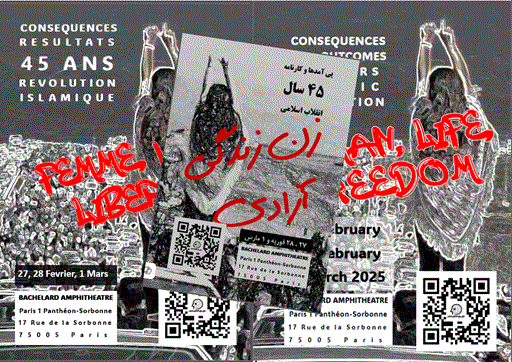
    Consequences and Outcomes of 45 Years of the Islamic Revolution: “WOMAN LIFE FREEDOM”

    (February 27-March 1, 2025)

    Watch Day One Recording BELOW

    .

    Day One Thursday 27 February 2025
    9.30Meet & Greet
    10.00The Opening
     Dr Farhad Ameli – Vice Dean Sorbonne Law School
    Message to the Conference: Dr Nargess Eskandari – Mayor of Frankfurt
     Dr Hossein Ladjevardi – President, ACI
    10.30 Panel 1 (FARSI)
    ‘Woman Life Freedom’
    Panel Chair Dr Sima Sabet
    Nahid Bahmani UKWomen’s Rights Defender Komala Party of Iranian KurdistanWomen in Kurdistan: the duality of tradition and national oppression
    Rouhi Shafii  UKICAVIIranian women post Islamic Republic
    Zahra Bagherishad – Sweden (zoom)Researcher – Gender StudiesIranian Women’s Resistance and Progress in the Face of Oppression
    Dr Maryam Mousavi – France /  Leila Gharavi – FinlandOptometrist (MOptom) PhD in Optometry   /

    Doctoral Researcher, University of Helsinki
    Joint Paper
    presented by Dr M Mousavi
    Adopting Practical Engineering Approaches to Problem-Solving in Bridging Sociopolitical Differences: A Proposal
    Sara Noaeen
    UK (ZOOM)
    Researcher, International Event ManagerExploring the Impact of Sporting Events on Democratization Efforts in Non-Democratic Societies (Iran)
    Dr Alireza Mansouri – CanadaMember of National Iranian Canadian Assembly (NICA), Expert in migration, citizenship, and refugee issues, and human rights activistBuilding a Free Iran: Revolution, Resistance, and Modern Tools for Change
    Saghi Gholipour – SwitzerlandActivist – Woman Life FreedomWhy Woman Life Freedom
    13:00 Break – Lunch
    13.30 –  PANEL TWO (FARSI)
    Looking at the Future of Religion and Belief
    CHAIR – ACI
    Ebrahim Ahrari – Malaysia
    (zoom)
    Spokesperson –
    National Council of Iranian Sunnis
    The Plight of Iranian Sunnis
    Azad Farsani – USA (zoom)Researcher – Philosophy and ReligionThe Future of Islam in Iran: Akin to Hitler’s Nazism and Fascism in Today’s Germany
    Dr Didier Idjadi – FranceSociologist – lecturerSecularism, Laicity and the future of Iran
    Prof Hesam Nowzari – USA (zoom)DDS, PhD Diplomate, American Board of PeriodontologySuperstitions in the Past 45 Years: Challenges and Solution
    Dr Hassan Fereshtian – FranceReligious Researcher and Jurist with Seminary Training In Ijtihad & university education in lawThe Future of the Religious Establishment in Post-Islamic Republic Iran
    15.00 BREAK
    15.15 – PANEL THREE (Farsi)
    Ethnic groups and diverse ethnicities of Iran
    CHAIR – ACI 
    Dr Reza Moridi 
    (ZOOM) Canada
    Ex – Ontario Minister of Training, Colleges and Universities, and Minister of Research, Innovation and Science – Senior Fellow at Massey College – University of TorontoEthnic groups and diversity in Iran
    Nasser Boladai UKGeneral Secretary of Balochistan Peoples PartyPlight of the Baloch people of Iran and the future
    Nahid Bahmani UKWomen’s Rights Defender Komala Party of Iranian KurdistanWomen in Kurdistan: the duality of tradition and national oppression
    Kawa Ahangari 
    Belgium
    Political analyst –
    Chief of Zagros news network
    The Iran of Tomorrow: Opposition and the elusive unity
    Dr Mansour Sohrabi – Germany Agroecologists – Environmental journalistViolation of Environmental Justice: A Special Investigation of Under Developed and Deprived Areas
    Omar Ilkhanizadeh 
    Sweden
    Deputy Chair – Komalah Party of Iranian KurdistanFuture of Iran: Pluralism, decentralisation, secularisation and parliamentary democracy
    17:30 –  BREAK
    17.45 – PANEL FOUR (FARSI)
    Iran’s Political Evolution: Debating Governance Models for the Future 
    CHAIR – DR HOSSEIN LADJEVARDI (ACI)  
    Iman Solaymani Amiri –
    Switzerland
    Legal Expert – Socio-Political researcher-commentatorWhy a Republican system is best for the future of Iran?
    Hon. Bijan Kian – USACofounder and President, Institute for Voices of LibertyWhy a Monarchist system is best for the future of Iran?
    Dr Kamran Matin  UKDirector – Centre for Advanced International Theory (CAIT) – University of Sussex Lecturer International RelationDemocracy Requires Decentralisation: A Critique of the Unitary Nation-State

    DAY ENDS 19:00

  • Executive Summary:  Baluchistan: Dignity, Freedom, and Justice for All

    Executive Summary: Baluchistan: Dignity, Freedom, and Justice for All

    Date: December 9, 2023
    Venue: London School of Economics (LSE)

    On December 9, 2023, ACI hosted a one-day seminar titled ‘Baluchistan: Dignity, Freedom, and Justice for All,’ addressing critical human rights issues and systemic injustices in the Baluchistan region. The seminar highlighted the challenges faced by the Iranian Baloch people over the past four decades, including discrimination, poverty, and violations of their religious, ethnic, and linguistic rights. Additionally, the seminar addressed the disproportionate use of the death penalty and the continued use of lethal force against unarmed civilians, raising serious concerns regarding crimes against humanity under the ICC Statute.

    The event coincided with the 75th anniversary of the Convention on the Prevention and Punishment of the Crime of Genocide, marking a significant occasion to reflect on the importance of human rights and justice for vulnerable populations like the Baloch people.

    Key Themes and Discussions:

    1. Discrimination, Poverty, and Human Rights
      The seminar delved into the historical and ongoing challenges facing the Baloch people, focusing on issues such as multidimensional deprivation, ethnic and linguistic discrimination, and violations of basic human rights. Testimonies and discussions illuminated the severe socio-economic conditions in the region, including lack of access to education, employment, and healthcare.
    2. Systematic Use of Lethal Force and the Death Penalty
      One of the key topics of the seminar was the excessive use of lethal force against unarmed civilians and the high rates of executions in Baluchistan, with many participants emphasizing the human cost of these practices. Discussions explored how these acts may constitute crimes against humanity under international law, particularly in the context of the International Criminal Court (ICC) Statute.
    3. Testimonies and Personal Accounts
      Human rights defenders, activists, and experts shared powerful testimonies that highlighted the personal and collective suffering of the Baloch people. Among the poignant speakers were Fariba Baloch, a human rights defender, and Mohsen Borhanzehi, who recounted the events surrounding the Maki Mosque massacre in 2022. These first-hand accounts underscored the human toll of state-sanctioned violence and systemic injustice in the region.
    4. International Perspectives and Legal Frameworks
      Experts such as Professor Payam Akhavan, Professor of International Law and Special Adviser on Genocide, and Professor Javaid Rehman, UN Special Rapporteur on Human Rights in Iran, provided a legal framework for understanding the situation in Baluchistan. They analyzed how international standards and state responsibilities intersect with the ongoing violations in the region and discussed potential avenues for accountability.
    5. The Right to Education
      A significant portion of the seminar focused on the denial of education and economic opportunity for the Baloch people, particularly women and children. Speakers like Ms. Shahin Nosrati and Laebe Aram highlighted the intersectionality of cultural traditions, economic deprivation, and the lack of educational access, particularly for Baloch women. The importance of education in breaking cycles of poverty and advancing human rights was emphasized as a vital area for future advocacy.
    6. Future Prospects for Balochistan
      Panel discussions also considered potential paths forward for the region, including the role of international advocacy, legal frameworks, and grassroots efforts in addressing the systemic issues faced by the Baloch people. Activists, political analysts, and journalists underscored the need for broader international attention and intervention to ensure justice, dignity, and freedom for the people of Baluchistan.

    Closing Remarks:

    The seminar concluded with an emphasis on the importance of international solidarity, legal accountability, and the need for sustained efforts to address the grave human rights violations in Baluchistan. Several messages from prominent figures reinforced the critical need for a focused global response to ensure the protection of the rights of the Baloch people, particularly in terms of education, economic opportunity, and the prevention of violence.

    In conclusion, the seminar served as a crucial platform for raising awareness, providing testimonies, and offering legal insights into the systemic injustices faced by the Baloch people in Baluchistan, and the need for urgent action to protect their dignity, freedom, and rights.

    ——————————————————

    Film: Panel 1 – Morning session (English)

    • Opening Remarks and Welcome – Dr Hossein Ladjevardi (Persian)
    • Dr Fereydoon Rahmani – Associate Professor, Programme leader – Human Rights & Equity Studies ‘Comparative look: international standards, State responsibilities and the situation in Balochistan’
    • Ms Sabah Bandouie -‘Balochistan Human Rights Group’ UN representative ‘44 years of intentional systematic injustice’
    • Fariba Baloch – Human Rights Defeder: ‘Testimony of a mother, a woman and a Baloch human rights defender’
    • Dr Sima Sabet – Iran Expert: ‘A Strategic look to Balochistan’

    Film: Panel 2 – Morning Session (English)

    • Hon. Bijan R. Kian – Former senior official of the United States Government: ‘Intentional economic development deprivation of specific regions in Iran linked with international narcotics trafficking’
    • Nasser Boladai  – Chairperson ‘Baluchistan People’s Party’ : ‘Crimes against humanity or inconsequential killings?’
    • Professor Payam Akhavan – Professor of International Law, Special Adviser on Genocide, ICC (TBC): ‘What are crimes against humanity?’
    • Professor Javaid Rehman – United Nations Special Rapporteur on the situation of human rights in Iran: ‘Balochistan and human rights’

    Panel 2 –  14:00-18:00 (Persian)

    Prospects for the future: Wider dimensions of poverty, multidimensional deprivation and discrimination based on religious, ethnic, and linguistic rights as told by activists and human rights defenders with special emphasis on the rights to education:

    • Dr Fereydoon Rahmani – Associate Professor, Programme leader: Human Rights & Equity Studies, ‘Comparative look: international standards, State responsibilities and the situation in Balochistan’
    • Mohsen Borhanzehi – Baloch Human Rights Defender: Testimonies from Iran: Maki Mosque 30 September 2022
    • Ms Fariba Baloch – Baloch Human Rights defender: Testimony of a human rights defender
    • Dr Roya Boroumand – Boroumand Foundation: Extra Judicial Killings and Executions
    • Ms Fariba Borhanzehi – Baloch child rights defender: Story of two little children – Hangol and Morid
    • Ms Shahin Nosrati – Writer, Women’s right defender: Women: Inequitable access to education and employment opportunities
    • Laebe Aram – Writer: ‘Intersectionality of culture, tradition and economic deprivation impacting the fate of Baloch women‘
    • Dr Abdolsatar Doshoki – political analyst: ‘Inequitable access to higher education’
    • Rahim Bandouie – ‘Baluchistan People’s Party’: ‘Economic discrimination and intentional poverty’
    • Masoud Raeisi – Journalist – ‘Poverty, multi-dimensional deprivation and prospects for the future‘
    • Messages from:
    • Dr Saeed Paivandi: Importance of education in building the future
    • Dr Rezvan Moghadam:  Stop Honour Killings!
    • Shirin Razavian: A poem for Balochistan
  • “Our Rights, Our Future, Right Now”

    “Our Rights, Our Future, Right Now”

    As the world commemorates the 76th Human Rights Day, we, as Iranians, face this moment with grave concern and uncertainty about our nation’s future. The theme this year calls us to act with urgency—and for Iranians, this call could not be more vital.

    “Human rights have a preventative role: By defending human rights, we can prevent harm before it happens.”

    Yet, in Iran, harm is not just a possibility; it is an everyday reality. The Islamic Consultative Assembly recently advanced the so-called “Family Protection Law through the promotion of chastity and hejab,” a measure that openly threatens the safety, liberty, and lives of Iranian women and children. Rather than preventing harm, these laws enshrine it in the name of control and oppression.

    “Human rights have a protective role: They shield against abuses, ensuring dignity and respect for all.”

    Iran’s theocratic legal system does the opposite—it legitimises and perpetuates systemic discrimination on the basis of gender and religion. These are not protections; they are mechanisms of subjugation that rob every Iranian of their fundamental rights and freedoms.

    “Human rights have a transformative role: They are a powerful force for good.”

    With the ‘Woman Life Freedom’ movement over the past two and a half years, Iranians—both within and beyond the nation’s borders—have spoken loud and clear. In the face of brutal oppression, they have risked and even sacrificed their lives for a future defined by freedom, justice, and equality. Their unwavering resistance embodies the transformative power of human rights in action.

    Today, as Iranians, we join the world in celebrating Human Rights Day with steadfast hope for a brighter future. We dream of a nation where every individual, regardless of gender, belief, or identity, can live with dignity, respect, and equality.

    But hope alone is not enough. To realise this vision, we need the international community to stand with us, amplify our voices, and hold the Iranian regime accountable for its violations. Together, we can ensure that the universal promise of human rights is not just a slogan but a lived reality—for Iran, and for all.

    This Human Rights Day, let us declare boldly: Our rights are non-negotiable, our future is worth fighting for, and the time to act is now.

    ACI Human Rights Committee

    December 10, 2024

  • Future Conference: Paris 2025

    Future Conference: Paris 2025

    .

    Consequences and Outcomes of 45 Years of the Islamic Revolution: “WOMAN LIFE FREEDOM”

    A Call to Action: Charting a Path Forward for Iran

    WATCH LIVE

    CONFERENCE PROGRAM

    Assciation des Chercheurs Iraniens (ACI), in collaboration with the Legal Research Institute of the Sorbonne in Paris, invites researchers and experts to submit abstracts for a three-day conference (February 27-March 1, 2025) at Université Paris 1 – Panthéon Sorbonne.

    Focus: Assessing the impact of the Islamic Revolution on Iran after 45 years and exploring realistic, achievable pathways towards a brighter future.

    Key Themes:

    • Social Protest Movements
    • Economy, Corruption, Organised Crime
    • Justice, Advocacy – Transitional Justice
    • Ethnic groups and diverse ethnicities of Iran
    • Religions and Beliefs
    • Healthcare and Medicine
    • Education
    • Climate change and Environment
    • The Role and Responsibilities of the Media  
    • Protest Art
    • “Woman, Life, Freedom”

    Our Goal:

    This conference aims to foster a frank and respectful dialogue among diverse perspectives. We believe that by collectively examining the past, present, and potential future of Iran, we can contribute to a more hopeful and achievable vision for the country.

    Call for Abstracts:

    We invite submissions in Persian, English, or French on a wide range of topics related to the conference theme. Abstracts (250-500 words) should be accompanied by a short biography and photograph of the author.

    Submission Email: conference (@) aciiran.com

    Submission Deadline: January 15, 2025

    Paper Requirements:

    • Full papers (2,000-5,000 words) due four weeks before the conference.
    • Microsoft Word format required.
    • Submissions should present original, well-researched arguments and solutions.

    Presentation Format:

    • Individual presentations (10-15 minutes) followed by Q&A (15 minutes).
    • Panel discussions.

    Important Information:

    • Conference languages: Persian, English, French
    • Accepted papers will be published in a post-conference book.
    • Travel and accommodation costs are the responsibility of participants.
    • Letters of acceptance and invitations can be provided upon request to facilitate visa applications.

    Let us join together to build a better future for Iran.

    Submit your abstract to aci@aciiran.com by January 15, 2025.

  • “Woman Life Freedom” – Survey

    “Woman Life Freedom” – Survey

    An Assessment of Identity Trends and Today and Tomorrow of Iran

    Full findings of the survey is available. Please contact is ‘survey (@) aciiran.com’

    Key Findings

    The survey titled “Woman Life Freedom” –  An Assessment of Identity Trends and  Today and Tomorrow of Iran provides a clear picture of the fundamental shifts in beliefs, identities, and attitudes within Iranian society. Conducted online over a 21-day period from February 1 to 22, 2024, the survey garnered 1881 responses from both within and outside of Iran.

    Key findings from the survey include:

    • A significant decline in religious beliefs: This decline indicates a shift from religious identity towards other identities such as national and ethnic identity.
    • Strengthening of national and ethnic identities: The majority of respondents rooted their identities in Iran’s history and culture, placing less emphasis on religious identity.
    • A crisis of legitimacy: The political system faces a crisis of legitimacy as a result of widespread public distrust and perceptions of undemocratic governance.
    • Oligarchic tendencies: The data suggests a strong belief among the respondents that the political system is characterized by oligarchic tendencies, with power concentrated in the hands of a few.
    • Structural inequalities and insecurity: Respondents reported widespread experiences of discrimination, particularly against women, as well as significant concerns about economic and job security, suggesting underlying structural inequalities.

    Given the widespread dissatisfaction, perceptions of injustice, and discrimination revealed in the survey’s comparative analysis, the emergence of a grassroots movement such as ‘Woman, Life, Freedom’ was not unexpected. The courage demonstrated by young people and women in the face of severe repression during street protests garnered significant and unprecedented international attention within the first few months.

    Our findings indicate that the ‘Woman, Life, Freedom’ movement has faced significant challenges, including severe repression, economic constraints, and a lack of a cohesive structure. Social media has played a pivotal role in mobilizing the public and disseminating information. To strengthen the movement and achieve its goals, there is a need for a unified structure, increased coordination among domestic and international activists, a clear vision for the future, and sustained international support

    Conclusion:

    The survey results indicate that Iranian society is undergoing a transition towards a more modern and democratic society. The internet and social media play a pivotal role in facilitating communication and providing free access to information. Civil society has a crucial role to play in this transition and should strive to achieve this goal through sustained planning and effort.

    Recommendations for International Action:

    Based on the survey findings that reveal increasing dissatisfaction and widespread distrust of the political system, and aiming to support the aspirations of the Iranian people, given the crucial role of the internet and social media in facilitating peaceful dialogue between Iranians and the international community, the following requests can be made to the international community:

    1. Support for unrestricted internet access: Assisting in circumventing internet filtering and providing secure infrastructure.
    2. Targeted sanctions: Imposing targeted sanctions on officials and institutions responsible for human rights abuses in Iran.
    3. Human rights protection:
      • Establishing international mechanisms to monitor the human rights situation in Iran.
    4. Support for victims and survivors of state violence:
      • Providing humanitarian assistance to victims and survivors.
      • Supporting asylum seekers, refugees and displaced persons.
      • Establishing mechanisms to protect witnesses.
    5. Support for civil society:
      • Support organizations and activists working for democratic change in Iran.
      • Establish funds to provide financial assistance to the families of those imprisoned or on strike.
      • Promote the development of independent media and freedom of expression.
      • Advocate for the release of political prisoners and the respect for human rights.
    6. Condemnation of censorship and repression: Issuing condemnatory statements, sanctioning companies producing censorship equipment, and supporting journalists and civil activists.

  • SURVEY: WOMAN LIFE FREEDOM

    SURVEY: WOMAN LIFE FREEDOM

     An Assessment of Identity Trends and Today and Tomorrow of Iran

    Please help us in understanding the events in Iran since the tragic death in custody of Mahsa Jina Amini by completing this survey. It shouldn’t take more than a few mi

    This public opinion survey will measure the generational changes, trends, and tendencies in how Iranians identify themselves and how they view their future. It is a comparative study to a previous survey concerning Iranian identity and the future of Iran.

    With ‘Woman Life Freedom Movement’ and the unfolding of recent events in Iran, the need for such a study has never been more evident. Understanding why we are where we are today will guide the way forward.

    Since our last study, Iranians have experienced worsening cultural, societal, economic, and political problems at home, and the regime’s actions in the region and the wider international community have brought tough sanctions, increasing isolation, and the threat of military strikes.

    In our opinion, assessing identity trends is of significant value since in the last forty-four years the Islamic regime has taken it upon itself to replace the diverse religious, cultural, ethnic, and linguistic identities of Iranians throughout Iran with that of their particular version of Shia Islam.

    As always, we have confidence that the findings will enable us to discuss and offer plausible options for building a better future for Iran and its people.

    Thank you for taking a few minutes to complete this survey.

  • ‘Baluchistan’: Dignity, Freedom, and Justice for All

    ‘Baluchistan’: Dignity, Freedom, and Justice for All

    The situation of civil, political, economic, social, cultural rights of the Iranian Baloch people

    December 9, 2023 – Marshall Building, LSE – London

    ACI is holding its fifty second international conference dedicated to the plight of the Iranian Baloch People to coincide with the seventy fifth anniversary of UN Human Rights Day with its theme of ‘Dignity, Freedom and Justice for All’.

    This one day seminar proposes to discuss the wider dimensions of poverty, multidimensional deprivation and discrimination based on religious, ethnic and linguistic rights to give context to the grievances and challenges facing the Iranian Baloch People in over four decades. Along with the issues concerning discrimination, poverty and human rights, the question we aim to discuss further is the continuous disproportionate use of the death penalty and the systematic use of lethal force against unarmed civilian population leading to many deaths in the Baluchistan region with regard to the ICC Statute and crimes against humanity. December 9, 2023, also marks the 75th anniversary of the landmark Convention on the Prevention and Punishment of the Crime of Genocide (Genocide Convention). This was the first human rights treaty adopted by the General Assembly.

    Panel 1 – 10:00 – 13:00 (ENGLISH)

    Along with the issues concerning discrimination, poverty and human rights, the question we aim to discuss further is the continuous disproportionate use of the death penalty and the systematic use of lethal force against unarmed civilian population leading to many deaths in the Baluchistan region with regard to the ICC Statute and crimes against humanity:

    Film: Panel 1 – Morning session (English)

    • Opening Remarks and Welcome – Dr Hossein Ladjevardi (Persian)
    • Dr Fereydoon Rahmani – Associate Professor, Programme leader – Human Rights & Equity Studies ‘Comparative look: international standards, State responsibilities and the situation in Balochistan’
    • Ms Sabah Bandouie -‘Balochistan Human Rights Group’ UN representative ‘44 years of intentional systematic injustice’
    • Fariba Baloch – Human Rights Defeder: ‘Testimony of a mother, a woman and a Baloch human rights defender’
    • Dr Sima Sabet – Iran Expert: ‘A Strategic look to Balochistan’

    Film: Panel 2 – Morning Session (English)

    • Hon. Bijan R. Kian – Former senior official of the United States Government: ‘Intentional economic development deprivation of specific regions in Iran linked with international narcotics trafficking’
    • Nasser Boladai  – Chairperson ‘Baluchistan People’s Party’ : ‘Crimes against humanity or inconsequential killings?’
    • Professor Payam Akhavan – Professor of International Law, Special Adviser on Genocide, ICC (TBC): ‘What are crimes against humanity?’
    • Professor Javaid Rehman – United Nations Special Rapporteur on the situation of human rights in Iran: ‘Balochistan and human rights’

    Panel 2 –  14:00-18:00 (Persian)

    Prospects for the future: Wider dimensions of poverty, multidimensional deprivation and discrimination based on religious, ethnic, and linguistic rights as told by activists and human rights defenders with special emphasis on the rights to education:

    • Dr Fereydoon Rahmani – Associate Professor, Programme leader: Human Rights & Equity Studies, ‘Comparative look: international standards, State responsibilities and the situation in Balochistan’
    • Mohsen Borhanzehi – Baloch Human Rights Defender: Testimonies from Iran: Maki Mosque 30 September 2022
    • Ms Fariba Baloch – Baloch Human Rights defender: Testimony of a human rights defender
    • Dr Roya Boroumand – Boroumand Foundation: Extra Judicial Killings and Executions
    • Ms Fariba Borhanzehi – Baloch child rights defender: Story of two little children – Hangol and Morid
    • Ms Shahin Nosrati – Writer, Women’s right defender: Women: Inequitable access to education and employment opportunities
    • Laebe Aram – Writer: ‘Intersectionality of culture, tradition and economic deprivation impacting the fate of Baloch women‘
    • Dr Abdolsatar Doshoki – political analyst: ‘Inequitable access to higher education’
    • Rahim Bandouie – ‘Baluchistan People’s Party’: ‘Economic discrimination and intentional poverty’
    • Masoud Raeisi – Journalist – ‘Poverty, multi-dimensional deprivation and prospects for the future‘
    • Messages from:

    Organised by Association des Chercheurs Iraniens (ACI) in collaboration with Azadi Network and Balochistan Human Rights Group

  • ‘Balochistan’ – ‘Dignity, Freedom, and Justice for All’

    Press Release : ‘Tehran funds Hamas while starving children at home’.

    The situation of civil, political, economic, social, cultural rights of the Iranian Baloch People

    Saturday 9 December 2023 – 10:00-13:00 English, 14:00-18:00 Persian

    Marshall Theatre, The Marshall Building, LSE, 44 Lincoln’s Inn Fields, London WC2A 3LY

    (On Saturday the Entrance is accessed through Portugal Street opposite the LSE Library)

    SPEAKERS LIST

    One day seminar in London examines possible ‘crimes against humanity’ committed against Iranian Baloch people on ‘Zahedan’s Bloody Friday’ with UN rights experts and Baloch minority activists and human rights defenders.

    While with the Israel-Gaza war, Iran’s prioritising of funding for terrorism is headlining international news, at home the latest annual budget keeps the Balochistan province as the most deprived and under invested province in Iran.

    The seminar will hear from Baloch activists who accuse the regime of intentional policies of keeping the region underdeveloped and deprived to further its aim of illicit gain from drugs smuggling. The ingress point for Billions of dollars in street value of narcotics is 565 miles of the province’s common border with Pakistan and 572 miles of common border with Afghanistan.

    The morning panel (10am-1pm) in English, will hear from Prof Javaid Rehman the UN Special Rapporteur on the situation of human rights in Iran who has said that the “scale and gravity” of violations committed by Iranian authorities during the ‘Women Life Freedom’ movement in Balochistan pointed to “the possible commission of international crimes, notably the crimes against humanity of murder, imprisonment, enforced disappearances, torture, rape and sexual violence, and persecution”. Prof Payam Akhavan, Professor of International Law, Special Adviser on Genocide, International Criminal Court will discuss the recent events. The panel will hear firsthand accounts of the plight of families whose loved ones have been executed, killed and/or sustained life changing injuries during the ‘Bloody Friday’ on September 30, 2023.

    The afternoon panel (2-6pm) in Persian, examines the wider dimensions of religious and ethnic persecution and violence against the Iranian Baloch people through the regime’s economic and security policies. Poverty is deep-rooted. According to a Baloch MP in April this year ‘deep rooted poverty in the region means that people can only afford to eat subsidised bread and provisions for that are even failing to meet the demands’. Reports on the region’s inequitable access to education, housing, healthcare, employment, and crumbling infrastructure will examine their impact on the rights of women and children in particular.

    Looking to the future, the seminar will conclude with its call for action and recommendations. Ends.

    Further information

    Organised by Association des Chercheurs Iraniens (ACI) in collaboration with Azadi Network and Balochistan Human Rights Group

    Background information:

    Sistan and Balochistan, the third largest of Iran’s 31 provinces, sits in the southeast corner of Iran with access to the waters of the Persian Gulf. It borders Pakistan and Afghanistan.

    Balochistan has 3.3 million inhabitants. It is also home to over 700000 Afghan refugees. It has had one of the highest rates of population growth in Iran with 67% of the population below 30 years of age. 28% of this group are between 15-30 years of age. This young population presents huge potential for future growth if planned for correctly while simultaneously creating real problems for the regime that has so far failed to meet the demands and aspirations of the people.

    The Balochistan region in the most deprived province in Iran according to the Islamic Republic’s own figures. It has the worst access to education, healthcare, housing, employment opportunity. Over 60% of the population live under poverty line.

    At least 274 Baluch people have been executed for drug-related charges since 2021, 40% of all drug executions in that time period. This is while they only make up 2-5% of Iran’s population[1].

    On 30 September 2022, during Friday Prayers in Zahedan the regime’s forces opened fire on unarmed civilians. According to Amnesty International at least 82 Baluchi protesters and bystanders were killed in bloody crackdown. ‘Iranian security forces unlawfully killed at least 66 people, including children, and injured hundreds of others after firing live ammunition, metal pellets and teargas at protesters, bystanders and worshippers during a violent crackdown after Friday prayers on 30 September in Zahedan, Sistan and Baluchistan province, Amnesty International said today. Since then, another 16 people were killed in separate incidents in Zahedan amid an ongoing clampdown on protests. Evidence gathered from activists, victims’ families, eyewitness testimonies, and images and videos of the protests suggest the real death toll from Zahedan is likely to be higher.’[2]

    Poor water management and changing climate, have created draughts and debilitating dust storms which have severely impacted the lives of the indigenous people of the region[3].


    [1] https://iranhr.net/en/reports/35/

    [2] https://www.amnesty.org/en/latest/news/2022/10/iran-at-least-82-baluchi-protesters-and-bystanders-killed-in-bloody-crackdown/

    [3] https://www.nationalgeographic.com/environment/article/drought-climate-change-turn-iran-sistan-and-baluchestan-into-dust-bowl