Date: December 9, 2023 Venue: London School of Economics (LSE)
On December 9, 2023, ACI hosted a one-day seminar titled ‘Baluchistan: Dignity, Freedom, and Justice for All,’ addressing critical human rights issues and systemic injustices in the Baluchistan region. The seminar highlighted the challenges faced by the Iranian Baloch people over the past four decades, including discrimination, poverty, and violations of their religious, ethnic, and linguistic rights. Additionally, the seminar addressed the disproportionate use of the death penalty and the continued use of lethal force against unarmed civilians, raising serious concerns regarding crimes against humanity under the ICC Statute.
The event coincided with the 75th anniversary of the Convention on the Prevention and Punishment of the Crime of Genocide, marking a significant occasion to reflect on the importance of human rights and justice for vulnerable populations like the Baloch people.
Discrimination, Poverty, and Human Rights The seminar delved into the historical and ongoing challenges facing the Baloch people, focusing on issues such as multidimensional deprivation, ethnic and linguistic discrimination, and violations of basic human rights. Testimonies and discussions illuminated the severe socio-economic conditions in the region, including lack of access to education, employment, and healthcare.
Systematic Use of Lethal Force and the Death Penalty One of the key topics of the seminar was the excessive use of lethal force against unarmed civilians and the high rates of executions in Baluchistan, with many participants emphasizing the human cost of these practices. Discussions explored how these acts may constitute crimes against humanity under international law, particularly in the context of the International Criminal Court (ICC) Statute.
Testimonies and Personal Accounts Human rights defenders, activists, and experts shared powerful testimonies that highlighted the personal and collective suffering of the Baloch people. Among the poignant speakers were Fariba Baloch, a human rights defender, and Mohsen Borhanzehi, who recounted the events surrounding the Maki Mosque massacre in 2022. These first-hand accounts underscored the human toll of state-sanctioned violence and systemic injustice in the region.
International Perspectives and Legal Frameworks Experts such as Professor Payam Akhavan, Professor of International Law and Special Adviser on Genocide, and Professor Javaid Rehman, UN Special Rapporteur on Human Rights in Iran, provided a legal framework for understanding the situation in Baluchistan. They analyzed how international standards and state responsibilities intersect with the ongoing violations in the region and discussed potential avenues for accountability.
The Right to Education A significant portion of the seminar focused on the denial of education and economic opportunity for the Baloch people, particularly women and children. Speakers like Ms. Shahin Nosrati and Laebe Aram highlighted the intersectionality of cultural traditions, economic deprivation, and the lack of educational access, particularly for Baloch women. The importance of education in breaking cycles of poverty and advancing human rights was emphasized as a vital area for future advocacy.
Future Prospects for Balochistan Panel discussions also considered potential paths forward for the region, including the role of international advocacy, legal frameworks, and grassroots efforts in addressing the systemic issues faced by the Baloch people. Activists, political analysts, and journalists underscored the need for broader international attention and intervention to ensure justice, dignity, and freedom for the people of Baluchistan.
Closing Remarks:
The seminar concluded with an emphasis on the importance of international solidarity, legal accountability, and the need for sustained efforts to address the grave human rights violations in Baluchistan. Several messages from prominent figures reinforced the critical need for a focused global response to ensure the protection of the rights of the Baloch people, particularly in terms of education, economic opportunity, and the prevention of violence.
In conclusion, the seminar served as a crucial platform for raising awareness, providing testimonies, and offering legal insights into the systemic injustices faced by the Baloch people in Baluchistan, and the need for urgent action to protect their dignity, freedom, and rights.
Opening Remarks and Welcome – Dr Hossein Ladjevardi (Persian)
Dr Fereydoon Rahmani – Associate Professor, Programme leader – Human Rights & Equity Studies ‘Comparative look: international standards, State responsibilities and the situation in Balochistan’
Ms Sabah Bandouie -‘Balochistan Human Rights Group’ UN representative ‘44 years of intentional systematic injustice’
Fariba Baloch – Human Rights Defeder: ‘Testimony of a mother, a woman and a Baloch human rights defender’
Dr Sima Sabet – Iran Expert: ‘A Strategic look to Balochistan’
Hon. Bijan R. Kian – Former senior official of the United States Government: ‘Intentional economic development deprivation of specific regions in Iran linked with international narcotics trafficking’
Nasser Boladai – Chairperson ‘Baluchistan People’s Party’ : ‘Crimes against humanity or inconsequential killings?’
Professor Payam Akhavan – Professor of International Law, Special Adviser on Genocide, ICC (TBC): ‘What are crimes against humanity?’
Professor Javaid Rehman – United Nations Special Rapporteur on the situation of human rights in Iran: ‘Balochistan and human rights’
Panel 2 – 14:00-18:00 (Persian)
Prospects for the future: Wider dimensions of poverty, multidimensional deprivation and discrimination based on religious, ethnic, and linguistic rights as told by activists and human rights defenders with special emphasis on the rights to education:
Dr Fereydoon Rahmani – Associate Professor, Programme leader: Human Rights & Equity Studies, ‘Comparative look: international standards, State responsibilities and the situation in Balochistan’
Mohsen Borhanzehi – Baloch Human Rights Defender: Testimonies from Iran: Maki Mosque 30 September 2022
Ms Fariba Baloch– Baloch Human Rights defender: Testimony of a human rights defender
Dr Roya Boroumand – Boroumand Foundation: Extra Judicial Killings and Executions
Ms Fariba Borhanzehi – Baloch child rights defender: Story of two little children – Hangol and Morid
Ms Shahin Nosrati – Writer, Women’s right defender: Women: Inequitable access to education and employment opportunities
Laebe Aram – Writer: ‘Intersectionality of culture, tradition and economic deprivation impacting the fate of Baloch women‘
Dr Abdolsatar Doshoki – political analyst: ‘Inequitable access to higher education’
Rahim Bandouie – ‘Baluchistan People’s Party’: ‘Economic discrimination and intentional poverty’
Masoud Raeisi – Journalist – ‘Poverty, multi-dimensional deprivation and prospects for the future‘
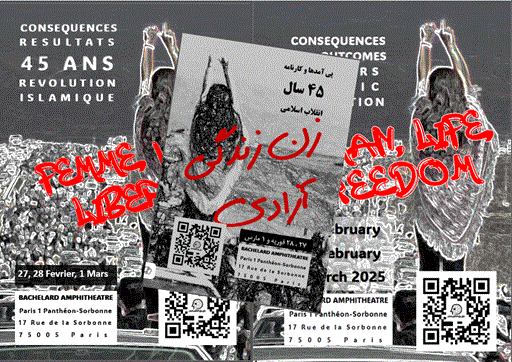
Assciation des Chercheurs Iraniens (ACI), in collaboration with the Legal Research Institute of the Sorbonne in Paris, invites researchers and experts to submit abstracts for a three-day conference (February 27-March 1, 2025) at Université Paris 1 – Panthéon Sorbonne.
Focus: Assessing the impact of the Islamic Revolution on Iran after 45 years and exploring realistic, achievable pathways towards a brighter future.
Key Themes:
Social Protest Movements
Economy, Corruption, Organised Crime
Justice, Advocacy – Transitional Justice
Ethnic groups and diverse ethnicities of Iran
Religions and Beliefs
Healthcare and Medicine
Education
Climate change and Environment
The Role and Responsibilities of the Media
Protest Art
“Woman, Life, Freedom”
Our Goal:
This conference aims to foster a frank and respectful dialogue among diverse perspectives. We believe that by collectively examining the past, present, and potential future of Iran, we can contribute to a more hopeful and achievable vision for the country.
Call for Abstracts:
We invite submissions in Persian, English, or French on a wide range of topics related to the conference theme. Abstracts (250-500 words) should be accompanied by a short biography and photograph of the author.
Submission Email: conference (@) aciiran.com
Submission Deadline: January 15, 2025
Paper Requirements:
Full papers (2,000-5,000 words) due four weeks before the conference.
Microsoft Word format required.
Submissions should present original, well-researched arguments and solutions.
Presentation Format:
Individual presentations (10-15 minutes) followed by Q&A (15 minutes).
Panel discussions.
Important Information:
Conference languages: Persian, English, French
Accepted papers will be published in a post-conference book.
Travel and accommodation costs are the responsibility of participants.
Letters of acceptance and invitations can be provided upon request to facilitate visa applications.
Let us join together to build a better future for Iran.
Submit your abstract to aci@aciiran.com by January 15, 2025.
An Assessment of Identity Trends and Today and Tomorrow of Iran
Full findings of the survey is available. Please contact is ‘survey (@) aciiran.com’
Key Findings
The survey titled “Woman Life Freedom” – An Assessment of Identity Trends and Today and Tomorrow of Iran provides a clear picture of the fundamental shifts in beliefs, identities, and attitudes within Iranian society. Conducted online over a 21-day period from February 1 to 22, 2024, the survey garnered 1881 responses from both within and outside of Iran.
Key findings from the survey include:
A significant decline in religious beliefs: This decline indicates a shift from religious identity towards other identities such as national and ethnic identity.
Strengthening of national and ethnic identities: The majority of respondents rooted their identities in Iran’s history and culture, placing less emphasis on religious identity.
A crisis of legitimacy: The political system faces a crisis of legitimacy as a result of widespread public distrust and perceptions of undemocratic governance.
Oligarchic tendencies: The data suggests a strong belief among the respondents that the political system is characterized by oligarchic tendencies, with power concentrated in the hands of a few.
Structural inequalities and insecurity: Respondents reported widespread experiences of discrimination, particularly against women, as well as significant concerns about economic and job security, suggesting underlying structural inequalities.
Given the widespread dissatisfaction, perceptions of injustice, and discrimination revealed in the survey’s comparative analysis, the emergence of a grassroots movement such as ‘Woman, Life, Freedom’ was not unexpected. The courage demonstrated by young people and women in the face of severe repression during street protests garnered significant and unprecedented international attention within the first few months.
Our findings indicate that the ‘Woman, Life, Freedom’ movement has faced significant challenges, including severe repression, economic constraints, and a lack of a cohesive structure. Social media has played a pivotal role in mobilizing the public and disseminating information. To strengthen the movement and achieve its goals, there is a need for a unified structure, increased coordination among domestic and international activists, a clear vision for the future, and sustained international support
Conclusion:
The survey results indicate that Iranian society is undergoing a transition towards a more modern and democratic society. The internet and social media play a pivotal role in facilitating communication and providing free access to information. Civil society has a crucial role to play in this transition and should strive to achieve this goal through sustained planning and effort.
Recommendations for International Action:
Based on the survey findings that reveal increasing dissatisfaction and widespread distrust of the political system, and aiming to support the aspirations of the Iranian people, given the crucial role of the internet and social media in facilitating peaceful dialogue between Iranians and the international community, the following requests can be made to the international community:
Support for unrestricted internet access: Assisting in circumventing internet filtering and providing secure infrastructure.
Targeted sanctions: Imposing targeted sanctions on officials and institutions responsible for human rights abuses in Iran.
Human rights protection:
Establishing international mechanisms to monitor the human rights situation in Iran.
Support for victims and survivors of state violence:
Providing humanitarian assistance to victims and survivors.
Supporting asylum seekers, refugees and displaced persons.
Establishing mechanisms to protect witnesses.
Support for civil society:
Support organizations and activists working for democratic change in Iran.
Establish funds to provide financial assistance to the families of those imprisoned or on strike.
Promote the development of independent media and freedom of expression.
Advocate for the release of political prisoners and the respect for human rights.
Condemnation of censorship and repression: Issuing condemnatory statements, sanctioning companies producing censorship equipment, and supporting journalists and civil activists.